Beginnings
The history of human civilization is intricately linked with the history of alcohol.
Yes, that is a bold statement to make- but perhaps not surprising when we realise that alcohol permeates the entire natural world around us. From insects laying their eggs in places where there is an intense odour of ethanol and acetaldehyde, to the predilection of birds and elephants towards consuming fermented food, many animals have an affinity towards alcohol, and humans are no exception.
Although the history of alcohol dates back atleast 10,000 years, and people thousands of years ago were definitely making mixed drinks, often mixing fermented beverages with spices, fruits, and herbs- the modern concept of mixed drinks is certainly a modern invention. The earliest English book on mixed drinks was ‘Oxford Night Caps’ by Richard Cook, first published in 1827. In 1862, Jerry Thomas, often called the Father of Mixology, wrote ‘The Bar-Tenders guide’, the earliest encyclopedia of mixed drinks aimed at bartenders.
At this time, in the early nineteenth century, the word “cocktail” entered the English lexicon, originating in the United States. Originally, cocktails included an alcoholic spirit, water, sugars and bitters, and gradually changed to include liqueurs. In the 1920s, the ambit of cocktails suddenly exploded owing to the Prohibition, which made alcohol illegal, drastically flooding the market with illicit, often subpar booze.
These cocktails became a means of masking the unpleasant flavour of this low-quality alcohol. Some popular Prohibition-era cocktails still popular to this day include Gin Rickey and Southside, the latter named after the Southside of Chicago, the area controlled by Al Capone. It was Capone’s favourite cocktail, and masked the inferior quality of the gin smuggled by his men.

The craze for cocktails persisted long after the end of the Prohibition, resulting in a wide plethora of mixed drinks with colourful names such as Monkey Gland (Gin, absinthe, orange juice and grenadine) and Hanky Panky (London dry gin, sweet vermouth and Fernet Branca). In an attempt to classify and codify this crazy cornucopia of cocktails, David Embury wrote “The Fine Art of Mixing Drinks” first published in 1948, in which he harked back to the classical age – a cocktail must be a ‘dry’ (not sweet) drink to whet one’s appetite prior to a meal.
As anyone who has looked at the cocktail section of a restaurant menu will agree, the cocktails of modern days are a far cry from the Spartan days of mid-nineteenth century, with fruit purees and spices and syrups and sauces making their presence felt, along with a myriad of alcoholic and non-alcoholic beverages. Indeed, some of the more common modern cocktails will probably make Embury squirm in his grave. The modern definition of “cocktail” is infinitely broader and more forgiving than the original.
However, some of the basic practices have remained unchanged. Cocktails are still an alcoholic drink, mostly (but not always) based on an alcoholic distilled spirit. Before moving on to actual cocktail making, let us take a brief look at some examples of its core component – the alcohol. In nature, alcohol is produced as a result of fermentation of carbohydrate-rich products by yeast to produce ethanol, which can then be filtered and purified, or further distilled to increase the alcohol content.
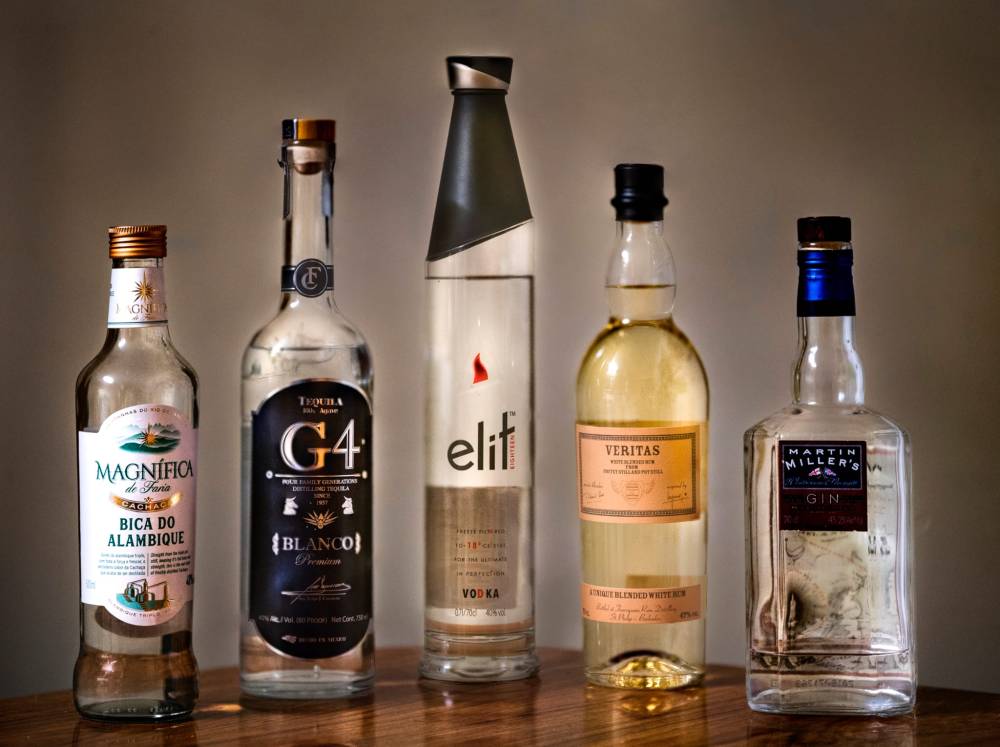
From a maker’s point of view, alcoholic beverages are of two types- the ones which are fermented but not distilled (wine and beer), and the ones which are distilled after they are fermented (rum, whiskey, brandy, etc.). The distilled beverages have a greater alcohol content, with non-distilled drinks having an alcohol content of <20%, and the alcohol content of distilled drinks going till upto the higher sixties or even more. Although there exists a large number of beer and wine-based cocktails, the most common ones employ a distilled beverage as its base.
Vodka can probably be considered as the base distilled spirit. It is as close to a neutral alcohol as possible- crystal clear in appearance, with as much of the flavour stripped off as possible by multiple rounds of distillation (usually up to 5 times) and filtration. It is largely devoid of many flavour compounds- just a mixture of neutral alcohol and water clocking at around 40% (or more) alcohol.
This makes vodka akin to a blank canvas- it appears infrequently in classic cocktails, where there is a more Spartan set of ingredients, but is often considered the most versatile spirit in a modern bar where it provides the perfect base for a variety of flavours to shine, from tomato juice and Worcestershire sauce in a Bloody Mary to the herbal anise-vanilla notes in a Harvey Wallbanger to the coffee liqueurs and heavy cream in a mudslide.

Other distilled spirits often have additional flavour notes in them. This can be from a lesser number of distillation steps preserving some of the original flavour compounds, as in the cases of unaged rum (produced from sugarcane molasses), cachaça (produced from sugarcane juice), tequila and mezcal (produced from agave), or from the addition of other notes after (or during, as in some varieties of gin) the distillation process.
Aroma notes can be introduced by aging the spirit in wood barrels, or via infusions. Rum, whiskey, and brandy – liquors distilled from sugarcane, grain, and grapes (or other fruits) respectively – are good examples of former. Often distilled a lesser number of times than vodka (2-3 times) to preserve some of the original flavour compounds, they are usually aged in oak barrels where they pick up a vast range of flavours from the chemicals naturally present in wood.
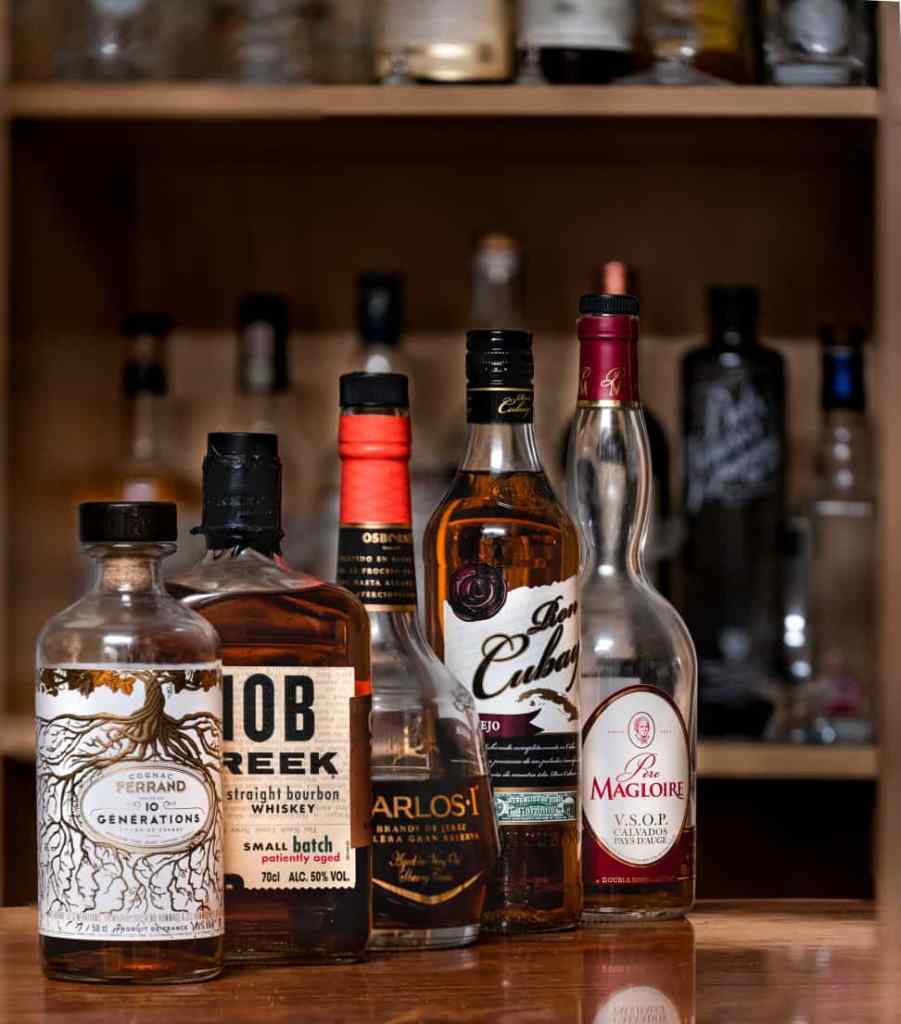
Infusion after or during the distillation process is another way of introducing flavours in an alcoholic spirit. Gin is the quintessential example of this category, tracing its origin to a juniper-infused alcohol used as a medicine as early as the 11th century AD. Even after nine hundred years, juniper remains the primary flavouring ingredient of gin, although modern gins do contain other herbs, flowers, and fruits both relatively mundane and exotic, ranging from as few as four to as many as forty-seven.
The infusions really come into their own in liqueurs, a category of alcoholic beverages with flavours from infused herbs, berries, nuts, and fruits, often with additional sugar. Whereas the distilled spirits described before usually act as bases of cocktails, liqueurs are the supporting cast rather than the lead role, although they are equally important in the art of cocktail-making. Liqueurs can be had on their own as well, either before a meal (aperitifs – Campari and Suze) or after (digestifs – Jagermeister and Limoncello).
The range of available liqueurs is incredibly large, from the coffee flavoured Kahlua, vanilla and anise flavoured Galliano, and chocolate flavoured crème de cacao, to the nut-based offerings of Amaretto (bitter almond) and Frangelico (hazelnut), from the fruit-infused delights of triple sec (orange) and crème de cassis (blackcurrant), to the brilliantly coloured concoctions flavoured with a wonderful mixture of exotic herbs as in Amaro, Benedictine and Chartreuse.
With some of the basics in place, its time to start mixing. Tune in next month for part 2 of the series where we take our first baby steps into the fascinating world of cocktail making.


 The Gourmet Glutton