This episode of The Cocktail Chronicles is a little different, and rather special. Since the Pujo season is upon us, I’ve decided to give the normal narrative a little break and focus on some original recipes, all centered around Bengali ingredients and flavours. The drinks are arranged from the simple to complex, and encompass a wide range of flavours as well as cocktail styles: aromatic, sour and dairy-based, to suit your taste.
Although most of my cocktails use a wide variety of liqueurs, aromatised wines and other spirits, I have tried to keep the alcoholic components to a bare minimum in these cocktails keeping their (lack of) availability in India in mind. Wherever possible, I’ve also included substitutions and hacks so that you can replicate these yourself. I hope these drinks help usher in the Pujo spirit (pun intended!)
শিউলির স্বপ্ন (Shiulir Swapno)
The first drink is the simplest and the most classic of the lot- an old fashioned flavoured with Nolen Gur, an essential component of the Bengali wintertime. Nolen gur, made from the date palm sap, is a quintessential ingredient of the Bengali winter that finds its way into numerous creations, from sandesh to pithe to payesh. The name of the cocktail is a pun, a nod to the hard work of the Shiuli, the workers who harvest the sap from the date palm trees, as well as a reference to the Shiuli flowers which are an essential part of the Bengali autumn.
Ingredients:
60 ml whiskey (rye or bourbon)
10 ml nolen gur
1 dash Angostura bitters
2 dashes orange bitters
Method:
Pour the nolen gur into the glass. Add the dashes of bitters, followed by the whiskey, and stir until well incorporated. Fill the glass with ice cubes and stir gently till ice-cold. Strain into an old-fashioned glass with one large ice cube. Twist the orange peel over the glass to release the essential oils. Garnish with an orange peel.
Bartender’s tip:
If Angostura and orange bitters are difficult to source, one can easily make aromatic Angostura-type bitters at home by infusing their choices of spices (clove, cinnamon, coriander, orange peel, cardamom) in neutral alcohol like vodka. Numerous recipes are available online.

দার্জিলিং মেল ১ (Darjeeling Mail 1)
The next two drinks are parts of a duo, since they’re tied together with a single ingredient that is a favourite of all Bengalis: tea. No adda is ever complete without a cup of cha, the perfect compliment to heated debates ranging from politics to football. The first in the series is based on lebu cha: lighter, fresher, with a subtle hint of salt in the background.
Ingredients:
45 ml dark rum
45 ml strong Darjeeling tea, chilled
22.5 ml lime juice
15 ml Grand Marnier
10 ml khejur gur (can swap with simple syrup, 1:1 ratio of water and sugar)
2-3 drops of black salt solution (50gm black salt in 250ml water)
1 dash orange bitters
Method:
Put all the ingredients in a cocktail shaker and shake with ice. Strain into a chilled glass. Garnish with an orange twist.
Bartender’s Tip:
In case you can’t find Grand Marnier, you can replace it with any other orange liqueur. If you can’t find any, you can add a few drops of orange blossom water or orange essence, and increase the amount of gur to taste. If you absolutely cannot find it, the orange bitters can be left out.
দার্জিলিং মেল ২ (Darjeeling Mail 2)
The second drink in our duo of tipsy teas is based on the Doodh cha, a richer concoction made with milk, and scented with spices, which I’ve replicated with the use of Angostura bitters. Whereas the previous one is based on the fresh and zesty lime juice, this one eschews the sourness for a rich, sweet, and dessert-y mouthfeel, although the hint of spices remain.
Ingredients:
45 ml dark rum
45 ml strong Darjeeling tea, chilled
22.5 ml evaporated milk
15 ml ginger liqueur
7.5 ml khejur gur (can swap with simple syrup)
1 dash Angostura bitters
Method:
Put all the ingredients in a cocktail shaker and shake with ice. Strain into a chilled glass.
Bartender’s Tip:
Since evaporated milk is difficult to find in India, you could make it at home by dissolving a cup of milk powder into 1.5 cups of warm water. If ginger liqueur and Angostura bitters are difficult to source, you could use a simple syrup infused with ginger and whole spices. Equally, one can muddle boiled ginger in the shaker and replace the evaporated milk with a teaspoon of condensed milk and a tablespoon of milk.

পথের পাঁচালী (Pather Panchali)
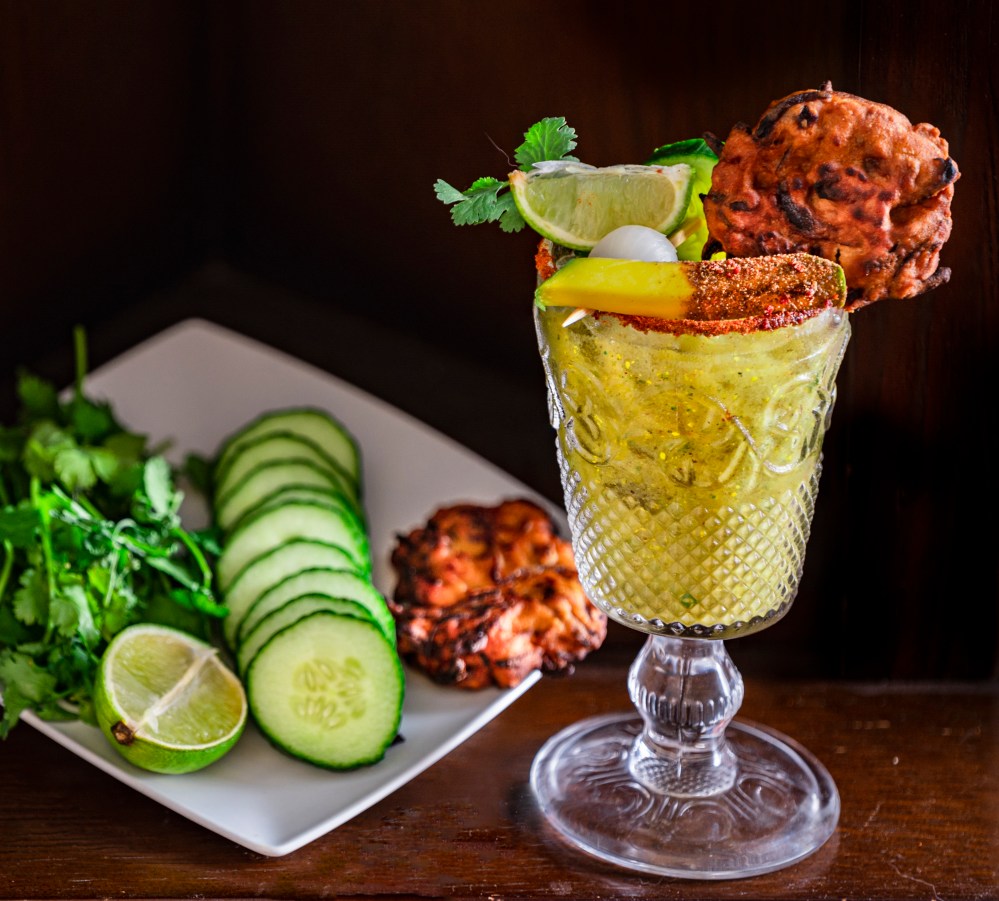
The final cocktail is a nod to Kolkata street food as well as summer ingredients like kacha aam (raw mango), and kasundi, the piquant mustard condiment that is often spiked with raw mango. The use of beetnoon (black salt), chaat moshla and ketchup lend it a rather savoury, lip-smacking flavour profile, as does the green chilli sauce, an ingenious condiment that is the product of the Indo-Chinese cuisine originating in Kolkata, which finds its way into street food classics like chowmein and egg roll. The name refers not just to the street food influences in the dish, but also to the scene in the classic book and movie where Apu and Durga eat aam er kushi (young mango buds) with shorsher tel (mustard oil).
Ingredients:
60 ml vodka
60 ml raw green mango puree
2.5 barspoons of kasundi
2 barspoons of green chilli sauce
0.5 barspoon tomato ketchup
Juice of one lime
Large pinch of black salt
Large pinch of chaat masala
Handful of coriander leaves
Method:
Rim a tall glass with a mixture of chaat masala and red chilli powder. Lightly muddle a few sprigs of cilantro in a cocktail shaker and mix all the ingredients with ice. Shake vigorously and strain into a tall ice-filled glass. Garnish as per your liking. I used garnishes include coriander sprigs, cucumber slices, lime and raw mango wedges, pickled onion, and deep fried onion fritters (peyaji).
Bartender’s Tip:
Different brands of kasundi and other sauces will differ in taste. Adjust the amount to your liking.

 The Gourmet Glutton