Pujo is just a month away. It is my first Pujo back home after three whole years, which feels great. Like every year, 2022 also has a series of great articles lined up for you during the festive season. There are guest articles and Pujo-specific writeups, and then there are articles celebrating the beauty of Bengali cuisine, like this one. The season is almost upon us, and it’s time to start getting into the festive mood!
Bengali cuisine is rather unique, in that it combines the communality of Italian cuisine with the rigor of French cuisine. While we have the whole family centered around the table, eating meals in with the social spirit of Thanksgiving dinner, we have certain rules in place regarding the sequence of dishes in a meal. While other cultures also have some degree of sequentiality to the meal, the subdivisions in a Bengali meal outnumber most other cultures. There are a lot of little steps that make a Bengali meal.
In the article on the biyebari feast, we’ve talked about the sequence in which dishes hit the table. The khichuri bhog for example maintains a sequence of savoury (khichuri-labra-beguni), bridge (chatni-papor), and sweet (rosogolla or mishti doi) hitting the plate one after the other. And even if things are all laid out at once in a Bengali meal, in an aiburo-bhaat for example, we will attack the dishes in a very specific order. And that is where it differs from a North Indian thali, where all dishes except the dessert can be had in any sequence.

What is interesting is, the same principle applies to the most basic domestic meals as well. You could of course, have a delightful meal of rice, daal and aloo posto. You could strip things even barer and just have sedhho bhaat with aloo bhorta. But even at this level you have a glorious interplay of flavours and textures. Be it a solo violin sonata by Bach or a 100-instrument symphony by Mahler, there is beauty at each level.
Unlike a homely North Indian dinner spread, where you keep switching between arbi ki sabzi and sarson ka saag to go with your roti while spooning dollops of creamy raita and cooling kachumber on your plate, in a similar meal in Bengal you would move sequentially from one dish to another. This article aims to tie most of the Bengali articles we have done so far in the context of the Bengali meal, be it the simple weekday lunch or the lavish biyebari dinner.

It is quintessentially Bengali to start the meal with something bitter. We’ve gone into immense detail about this course in a previous article, ranging from the simplest neem begun to would the complex shukto. While a lavish multi-course nemontonno-bari style meal will have a decadent shukto, a meal at home might have a tiny amount of neem begun or uchchhe bhaja, but in both cases, the formula is adhered to. It is just the complexity of the dish that changes. The idea of the bitter course, as we’ve already discussed, is to kick-start the taste buds and making them more receptive to the more complex dishes to follow.
A dish like uchchhe bhaja is a great bridge into the next course, the bhaja. In case you don’t start the meal with something bitter, you will definitely start with a bhaja. While neem begun and uchchhe bhaja technically fall into this category, the options are a lot broader. One of my favourites is shaak bhaja, a dish of fried up leafy greens which may range from notey shaak to palong shaak to even paat pata. A small amount of shaak with some kasundi, mixed up with rice is an absolute delight.

Bhajas can be simple, which range from the simple aloo-peyajkoli or phulkopi bhaja to the more elaborate kumror bora or narkel bora. And here is where comes in our next course, the daal. Depending on the occasion, it can be a simple homely musurir dal served with some aloo-phulkopi bhaja, or a decadent muro diye bhaja moong daal with beguni. The bhaat-daal-bhaja equation is an interplay of textures: the crisp bhaja provides a textural contrast to the mushy bhaat-daal. The same idea is at play when pairing a begun bhaja with khichuri or machh bhaja with panta bhaat. It’s all about that crunch.
And now come the array of proper vegetarian dishes. It is interesting to note just how much variety we have in the vegetarian realm, considering the predominantly pescatarian reputation we carry around everywhere. And dare I say, we have more variety in our vegetarian fare than a lot of pure vegetarian communities. Vegetarian sides can range from dry to saucy, from piquant to mild. Where it falls in the spectrum greatly dictates its sequence in the meal.
The dryish vegetarian dishes are served early, either with or just after the bhaja. Good examples in this category include the mild aloo posto, which almost straddles the realm of bhaja and torkari, to the mild mochar ghonto, to the sharp data chorchori. Dry vegetarian melanges can range from the sharp chorchori to the mellow ghonto, difference between the two clearly reflected in the cooking process; the former being fast and furious, the latter slow and gentle. Both of these can be had on their own or with dal.
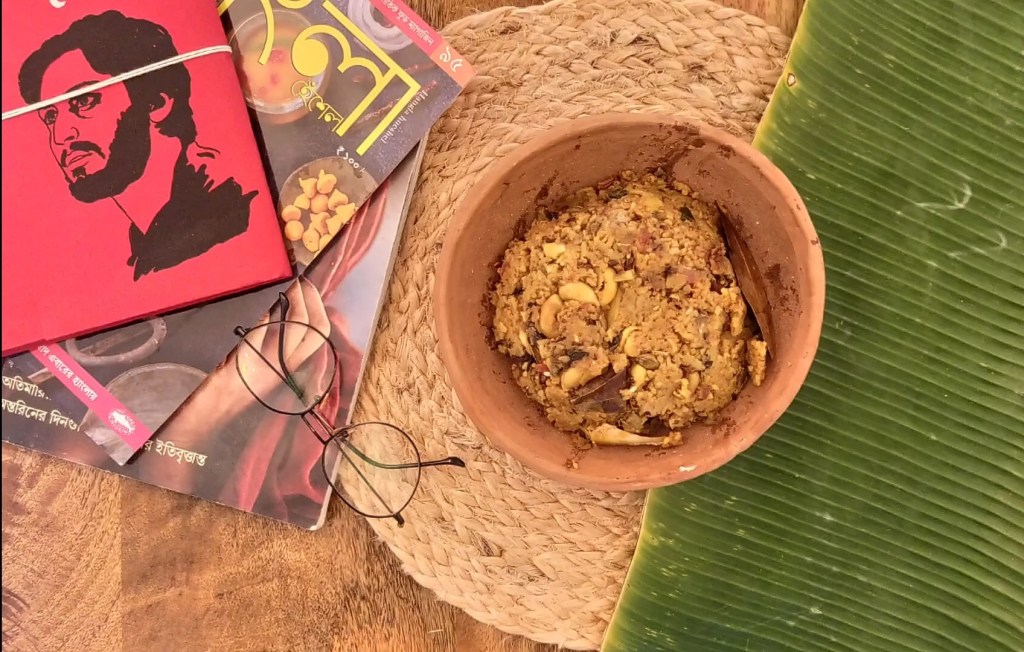
More elaborate versions of the chorchori or ghonto would be the laabra of a khichuri bhog or a decadent chhyachra made with fish head.
Other vegetarian dishes have a substantial amount of jhol, perfect with rice. Enter the dalna. Dalnas are usually much milder and saucier compared to a chorchori, and can range from the simple phulkopi-paneer er dalna, the epitome of comfort food, to the more elaborate dhokar dalna or chhanar dalna, often served in biyebaris. These are usually had after the dal is over, since the dish carries enough sauce on its own. After we’re done with the vegetarian part of the meal, it is time to move on to the next part.
While a non-vegetarian element is far from mandatory, you would usually find some sort of fish dish in a majority of Bengali meals. Again, it can range from the phulkopi diye bhetkir jhol which screams comfort food, to the decadent rui machher kalia from a biyebari spread. Sometimes, chicken or mutton might enter the equation, especially on special occasions. A patla murgir jhol can replace the machh er jhol on a weekday lunch, while a Sunday lunch may feature pathar jhol or even kosha mangsho. Although this bit can technically be called the main course, calling it so would be a serious injustice to the beautiful complexity of whatever has preceded it.
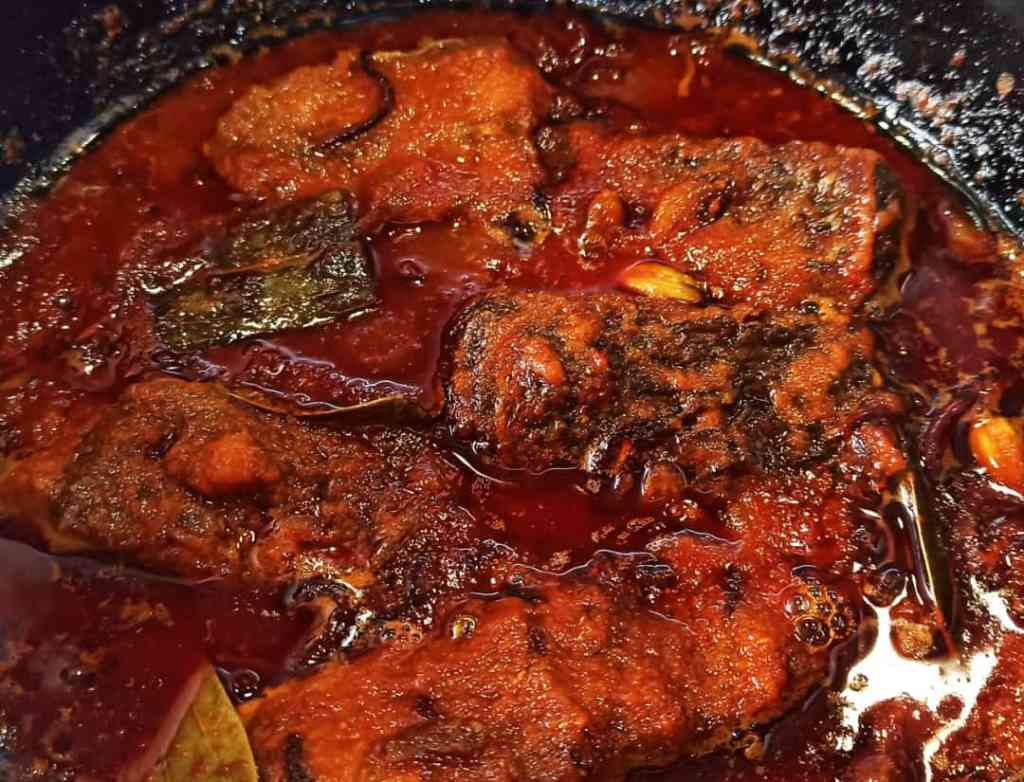
Before moving on, we must mention the one component that has accompanied the meal throughout. Rice is not merely a vehicle for these dishes, it becomes an integral part of each course. Daal would not be the same without bhaat, neither would the golden mangsher jhol taste as good unless it is mixed up thoroughly with the pristine white rice with a generous squeeze of lime for good measure. Unlike roti, rice blends in a lot more seamlessly into the meal. And unlike any roti, rice can hold its own in a meal. Just think of gobindobhog rice with ghee and kancha lonka, and you’ll realise what I’m talking about.
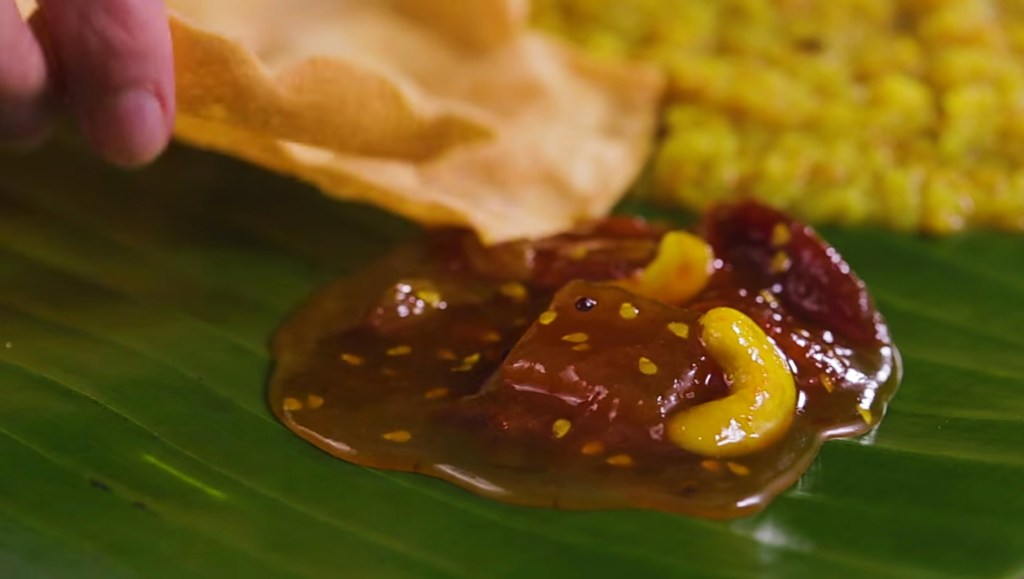
Where the French have their cheese course, we have the sour course. This becomes particularly important in the summers, when a cooling tok or ombol feels therapeutic on a hot summer day, especially with raw mangoes in season. If you want to jazz things up, you would make a machh er tok, which serves a very different purpose from the usual fish course, or you could make a chatni, be with jolpai and kacha aam in the summer to khejur and amsotto in the winter. Some crisp papor is the non-optional sidekick to any chutney, providing the essential crunch.
While the home meal might end at the sour course, since it provides a satisfying cadence as is, a more elaborate meal is bound to end with a number of sweets. The usual formula in most biyebaris is one dry sweet like a sandesh and one syrupy sweet like a rosogolla. If you’re lucky you could have a ladle of mishti doi as well.
So, next time you have a meal of shaak bhaja, aloo posto, pabdar jhal and aam er tok, think of how similar it is to a 12-course biyebari feast. And that is what makes our cuisine so special. Using the basic blueprint, we can craft meals from the ridiculously simple to the astonishingly complex.


 The Gourmet Glutton