Last Pujo, we dived deep into an exploration of fish in Bengali cuisine. We covered fish as a whole, right from the cacophony of the fishmarket to the stunning array of classics whipped up in the kitchen to the eating traditions. In this article, we will expand our lens beyond traditional Bengali home cooking and explore the role of fish in the broader picture of Calcutta cuisine. This year, with the corona scare more or less at bay, let’s step out of the kitchen to explore the restaurant scene.
The cabins and cafes of North Calcutta have a set of dishes that are entirely their own, a crucial part of the Calcutta food heritage. A detailed article on cabin culture and its food will have to wait its turn, but for now let us take a look at some of their fishy classics. One of my absolute favourites is the famous prawn cutlet from Allen’s Kitchen, a dish that even features in Rick Stein’s BBC documentary on India. A single prawn, bashed out flat and cooked with a delicate eggy batter that multiplies is volume and crisps up into frills, producing a slightly greasy but delicious concoction.

Just across the street from Allen’s we have Mitra Café, famous for another cabin classic. And no article on fish would be complete without mentioning the two staples of cabin cuisine: fish fry and fish kobiraji. While cheaper places may opt for fillets of basa, whose gelatinous texture is a major pet peeve of mine, the go-to fish of every self-respecting Bengali when it comes to these dishes is bhetki. It is a fish which yields excellent fillets, the perfect starting point for fish fry and kobiraji.
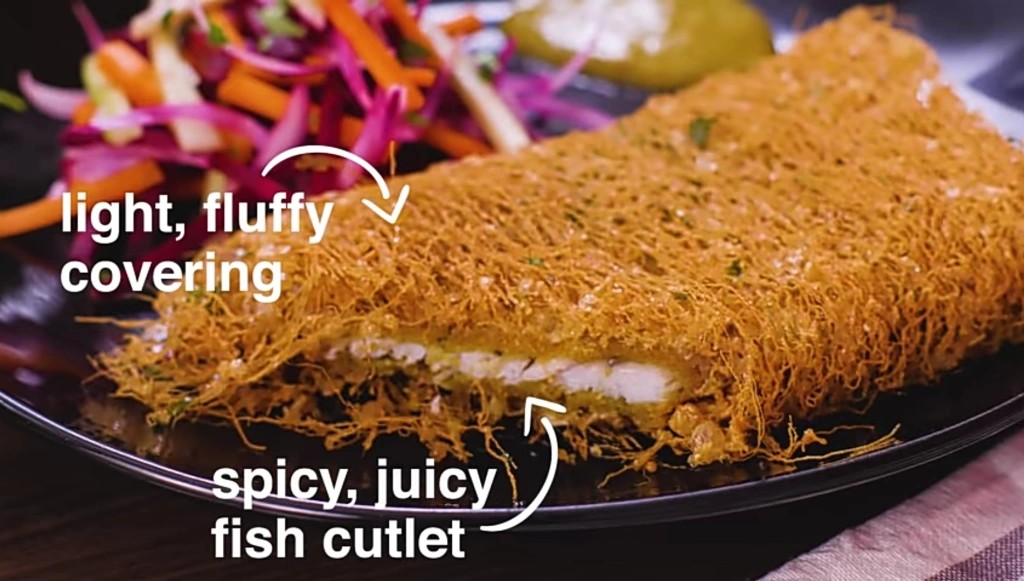
While the fish fry is breaded, the kobiraji, a British modification of the English “coverage” is battered, although the technique is unique and rather different from the battered fish and chips of the UK. The batter, a mixture of seasoned egg and flour is carefully drizzled over a lightly breaded fillet to produce a frilly mesh to encapsulate the cutlet. The traditional accompaniment to both dishes is kasundi, whose sharp piquancy cuts through the richness, and the famous cabin salad comprising a julienne of veggies like onion, cucumber and the mandatory beetroot.
The less reputed cousin of the dynamic duo of fish fry and kobiraji is the greasy fish batter fry, Bengal’s answer to British fish (and no chips), an annoying staple of the modern Bengali biyebari menu. Despite reeking of overcooked oil, middle aged kakus and kakimas perpetuate the tradition of calling them “butter” fry, delicately breaking open the greasy fish and commenting on the freshness of the bhetki, and getting visibly enraged when served subpar basa.
Bengali restaurants all over Kolkata serve up an array of fish dishes, from the time-tested classics to more unique, rather interesting concoctions, like the mourola machh er peyaji from 6 Ballygunge Place. Every monsoon, restaurants serve an array of dishes showcasing the king of fish, serving both classics like bhapa ilish and shorshe ilish, and more modern creations like boneless ilish fish fingers and the almost audacious ilish biryani.

These restaurants do a stellar job in keeping some of the more down-to-earth Bengali dishes alive. Kasturi serves up a delicious chorchori with the humble kaski machh, which one of my friends swears by. “If you haven’t had it, your life is a lie”, he says. And then there are the chic fusion dishes, like the beautiful chitol noodle soup from Sienna Café, which transforms the humble chitol machh er muittha into a fancy dish reminiscent of South East Asian noodle soups like laksa or pho.
These dishes really help keep tradition alive.
It is obvious that when foreign cuisines slowly assimilate into the tapestry of Calcuttan food culture, fish will make it way in rather seamlessly. Peter Cat’s iconic version of the French fish meuniere, which often resurfaces in Bengali weddings as Fish Munia (A for effort). Unlike the French classic which uses sole and a light lemon butter sauce, Peter Cat’s version uses bhetki fillets served with a light cream and herb sauce, a staple of classic Calcutta cuisine.

Just across the street, Mocambo also serves up a version of the Meuniere as well as the rather unique Fish Diana, with tiny pieces of prawn inside a fillet of bhetki (or beckty, as it is spelled on the menu), served in a cream sauce with a side of mash and steamed veggies. Although we haven’t really delved into the crustacean realm in this series, I think it would be unfair to not mention two of Mocambo’s iconic shellfish classics: the prawn cocktail and the devilled crab.
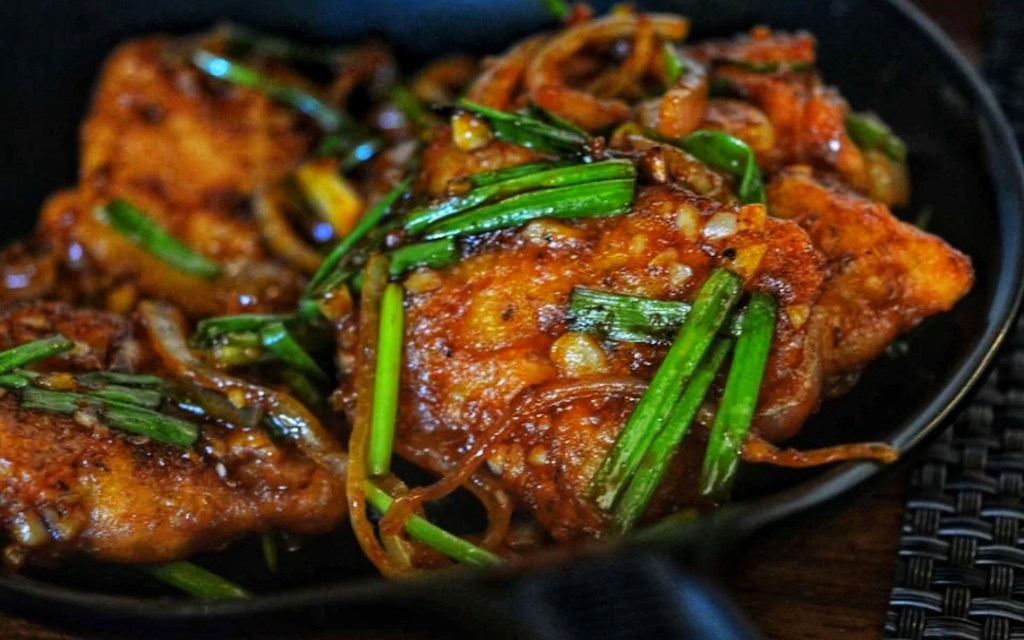
Basa and bhetki are staples of the Calcutta Chinese cuisine, with classics like pan fried chilli fish and sweet and sour fish. Restaurants like Mainland China serve up whole bhetki braised in a variety of Chinese sauces like chilli garlic and black bean, bringing together the best of both cuisines. Most good restaurants offer a choice between basa and bhetki, the latter being considerably more expensive. But the textures are a world apart, and no gastronome would hesitate chipping in the extra cash. And speaking of Calcutta Chinese, who can forget the iconic fish ball soup from the Territy Bazar breakfast spread, which feels like pure ambrosia on a chilly winter’s morning.
Over the past couple of decades, a number of restaurants of various cuisines have opened up across the city, expanding the Kolkata diner’s horizon, including fish. Modern diners are slowly but surely becoming more open to trying out fish in its raw form, a la sushi and sashimi, thanks to the multitude of Pan Asian restaurants opening up across the city. Even in the cooked realm, fresh seafood works brilliantly, like in the prawn Cheung fun, a Chinese dim sum staple which when made with the best local prawns, burst in your mouth with their plump lusciousness.
Though not yet as intricately assimilated into Calcutta cuisine as the fish fry or the fish meuniere as of now, these might very well integrate themselves into our food scene in a few years’ time. That is how cuisines have always evolved over time. And we can rest assured that in the land obsessed with fish, it won’t take long.

 The Gourmet Glutton