A Tale of Two Cities : Part 1
The skies were overcast, and there was a slight nip in the air. I briskly made my way towards my destination, one of those hyped fish and chips spots in London that serves you a grand version of the dish at a definitely steep price. But I didn’t mind. This was gonna be a one-time thing anyway, so might as well go all-out. I reached minutes after the doors opened, grabbed an outdoor seat just by the street, and placed my already-rehearsed order.
Fish and chips is the posterboy of British foods; if a person knows the name of just one British food it’s probably this. Fried stuff has a universal appeal, and this dish ticks all the right boxes. Tender, flaky white fish encased in a crispy batter, served with a side of chips which you can dunk into a selection of sauces, it is truly delicious and might I say, omnipresent in Britain. Every locality is bound to have one of these fish and chip shops, called chippies, churning out takeaway orders at an almost alarming pace, especially on Fridays.

The origins of the dish are murky. Fried fish was brought to the UK by immigrant Jews in the late 18th century. In Oliver Twist (1837)Dickens mentions “fried fish warehouses”, the likely precursor to the modern chippy. An 1845 recipe for “Fried fish, Jewish fashion”, involves deep-frying battered fish. The name comes from the practice of Saphardic Jews, ousted out of Portugal centuries ago, who would fry fish in a thin coat of flavour or matzo for Sabbath, the batter preserving the fish for consumption the next day.
Moving on from fish to chip. The French fry originated not in France but Belgium, where the 1680 winter was so cold that the River Meuse (located in present day Belgium) froze over and that the women in the area cut potatoes in the shape of fish and fry them in oil to feed their families. Dickens mentions “husky chips of potato fried with some reluctant drops of oil”, this time in “A Tale of Two Cities” in 1859. Sometime in the 19th century, the Jewish fish and the Belgian chips were brought together in holy matrimony, and the rest is history.

The fish of choice is cod or haddock, and the batter is often spiked with beer for extra flavour and fizz. And while good fish speaks for itself, especially if the batter is crisp, the potatoes need some help. Mention here has to be made of Heston Blumenthal, mad chef extraordinaire and owner of the iconic Fat Duck. The version of fish and chips he serves at his other restaurant, The Hinds Head, creates a super-crispy batter by passing it through a siphon gun. But it is his chips that are truly extraordinary.
The recipe starts with a starchy spud cut into thick batons and simmered in water for 20-30 minutes till they are almost falling apart, before being drained and stashed away into the freezer for an hour to dry out. This creates a craggly surface with more surface area to crisp up during cooking. The now dry chips are deep-fried, first at a lower temperature of 130 Celsius till a light crust is formed. These are drained and stashed away in the freezer for another hour.

This step is crucial, as it ensures that almost all of the moisture escapes from the chips, moisture that could seriously hinder crispiness. Once dried out, the chips then undergo a final fry at 180 degrees until golden brown and crisp. Had the frying been done in a single step, the moisture still trapped inside the potato wouldn’t have had a chance to escape, and the potatoes wouldn’t crisp up as much. The crucial step of drying out the fries creates a brittle, glassy crust with a fluffy, pillowy center.
The chips served alongside are much chunkier than American French fries, who by the way, reserve the term “chips” for what British call “crisps”. And then there are the accoutrements. While there are multiple options on offer, from pickles made of onion, gherkin and even eggs, to crunchy coleslaw, tangy baked beans and even crispy bits of batter fished out of the oil (called “scraps”), three of these have earned global repute.

The king of fish and chip accompaniments is undoubtedly the tartar sauce, named after the classic French dish called steak tartare which uses similar ingredients to season the raw beef, a dish believed to have been inspired by the Tartar people of central Asia. The sauce starts with a base of mayo into which is added finely chopped gherkins and capers followed by a handful of herbs like dill and tarragon and spiked with lemon and Worcestershire sauce. It is the perfect acidic respite to all the grease, scrubbing your palate clean before the next bite.
Next up is mushy peas, made with marrowfat peas which tend to be starchier than the fresher garden pea. Cooked in stock and finished with mint, it is a classic accompaniment. And then there is the curry sauce, a dish clearly influenced by Indian cuisine. Indeed, curry powder appeared in Victorian England and has become a staple of their cuisine, most notably in the form of a myriad of curries served up by British curry houses that mostly appeared post World War II.
The method of making a curry sauce is interestingly similar to a Japanese curry sauce which also uses curry powder. The sauce involves creating a roux, mixture of flour and butter into which goes the curry powder and an assortment of aromatics. The whole thing is cooked down and then blended into a thick sauce. White, green and beige, the three sauces add an element of colour to the monochromatic boredom of the battered fish and fried potatoes.

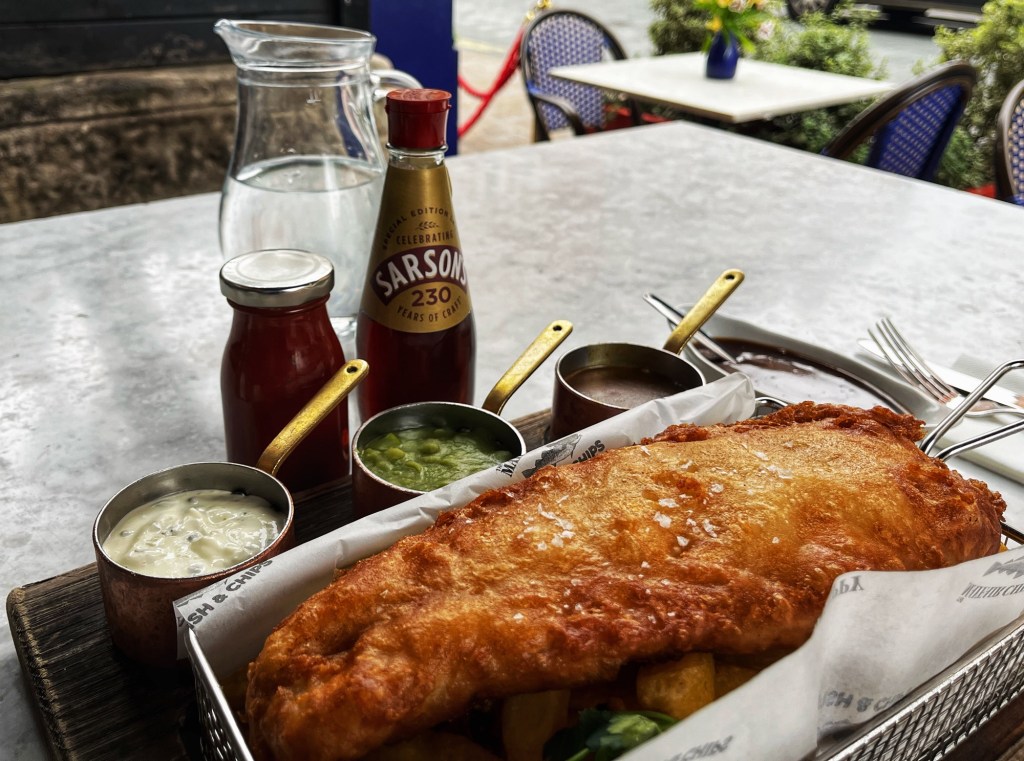
The version at the Mayfair Chippy included a ginormous portion of fried cod that was served atop a bed of chips, with three bowls containing the “big 3” accompaniments. The dish comes with a wedge of lime to squeeze onto the fish, along with ketchup and malt vinegar on the side. You can mix and match the components and improvise with each bite. Crunch into the batter, dip a chip into the mushy peas, mop up some of the curry sauce with a bit of fish, savour a tiny bit of tartar sauce all on its own to reset the palate, and repeat.
While fish and chips itself is a product of a combination of two different culinary imports into the UK, it itself travelled thousands of miles to India, from whence it imported the curry sauce to flavour its chips, while simultaneously metamorphosing in a foreign land. More on that next time.

 The Gourmet Glutton