Poached Pears with Fig “Custard” and Cinnamon “Crumble”: A “Recipe”
Christmastime calls for something special. So far, during Christmas, I’ve looked back at my first ever food article called Food and the Senses in 2019, dissected the Calcutta Christmas Cake in 2020, and collaborated with Nodee di on the Christmas dinner in 2021. This time, it’s time to try out something I haven’t done beforehand: recipes.
And it’s only apt that my first ever recipe is a dessert, the most important course of the meal (allegedly, allegedly). This is not your usual dessert candidate for the holidays, but definitely encapsulates the flavours of the season. Most fancy desserts need fancy ingredients and expensive equipment, but I like to find my way around it. There’s lots of corner-cutting (enough to make Adam Ragusea proud), none of which should be too apparent in the final dish. The title is a callback to an article I wrote in summer this year, reviewing a nice, summery dessert.
The dish, on the other hand, is based on the flavours of Christmas, with winter pears, dried figs, and warm notes of cinnamon. The centerpiece of the dish is the poached pear. Traditionally, they’re poached in wine until soft enough to be cut with a spoon, but not so soft that they disintegrate into mush. You could up the Christmas factor by adding mulled wine, laden with a multitude of ingredients like cloves, ginger, and orange peel, but I’m keeping this one simple. This is a dessert more suited to a cook rather than a hardcore baker, a perfect, light ending to a rich, indulgent meal.
The “recipe” starts with two cups of water and a cup of sugar (people on a diet, look away) infused with the flavourings of choice. I used a large stick of cinnamon and three cardamom pods, but you could also use more Christmassy ingredients like ginger, cloves, or allspice. When the water starts to simmer, in go the pears, peeled, quartered and cored. I tried being lazy and cooking them with skin on, but peeling the pears makes a significant improvement in texture, so don’t skip this step. Also, make sure the pieces are more or less submerged in the liquid so that they cook evenly, and if you much water evaporates you can top it off with a bit more, a slightly inefficient compromise in case you start off with too little water, like I did the first time around.
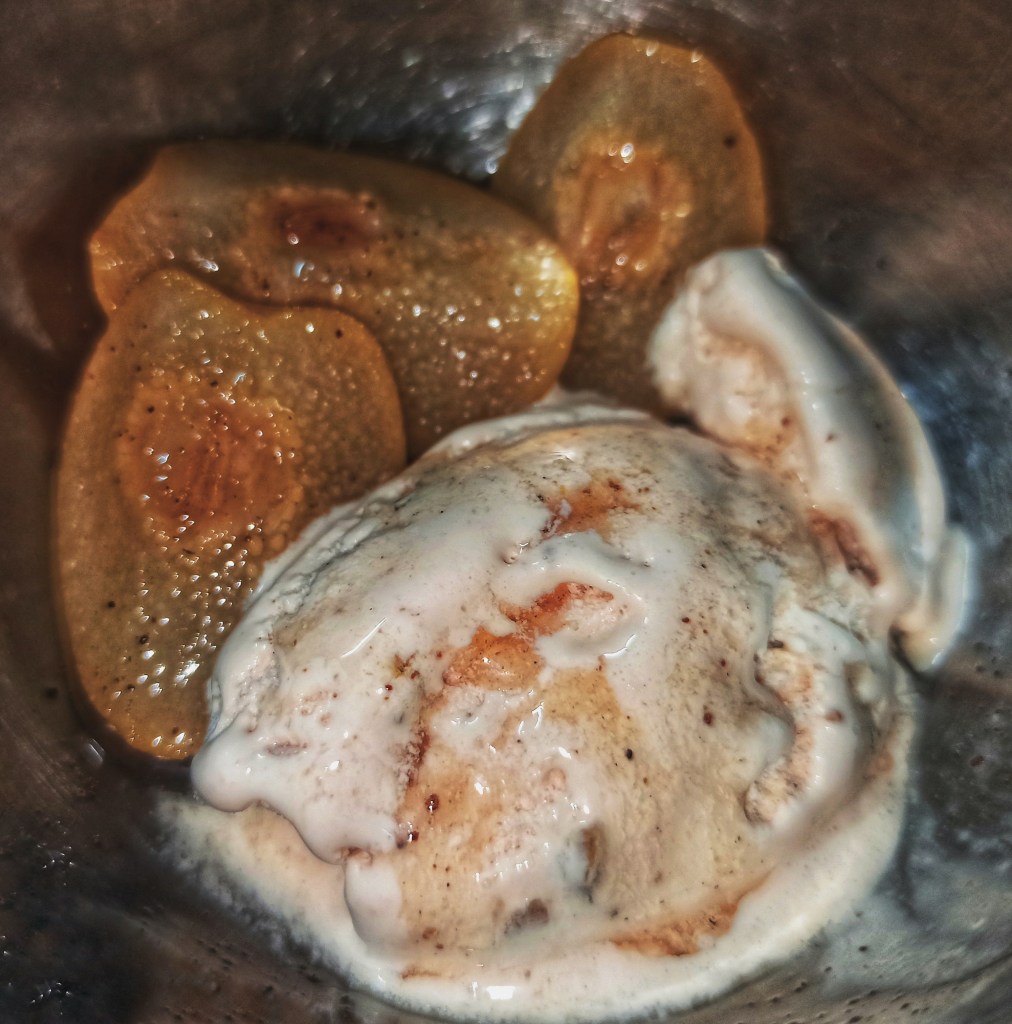
The pristine bite of the poached pear pairs well with something creamy, the final nail to the coffin for anyone looking for a “healthy fruit dessert”. Traditionally, you could make a crème anglaise from scratch, with eggs, sugar and milk; or you could cheat with some melted ice cream. I did try it with a scoop of ice cream, but I felt that the melted form worked better, enrobing the humble pear in voluptuous velvet. Chocolate lovers can look to the Poires Belle Helene, a French classic of poached pear dipped in a chocolate sauce: the pairing is a classic in French cuisine. You could put an Indian twist to it, by flavouring the syrup with saffron and cardamom, and serving it with a rabdi. The possibilities are endless.
You could easily get away with a vanilla ice cream, but I wanted to take it a step further, since it didn’t involve any extra effort on my part (I was gonna order in the ice cream anyway). I turned to my go-to reference for flavour pairings, Niki Segnit’s Flavour Thesaurus, which introduced me to a combo I had never thought of before: fig and cinnamon. I love fig ice cream, and adding it would bring to the dish another element of texture: the chewiness of reconstituted dried fig, a nice, fruity foil to the fresh bite of the poached pear. So, fig it will be. When the ice cream arrived, I merely let it sit at room temp for sometime, metamorphosing it into a delicious puddle.
Meanwhile, my pears have been cooking away for twenty minutes or so. I test them with a knife, it slides in easily. Done. Out come the pears, and set aside to cool. The poaching liquid gets the attention now, with the heat cranked up high so that it reduces into a syrup. I add in some ground cinnamon towards the end to boost the cinnamon flavour, and squeeze in some lime to add a bit of fresh zing, the only source of acid in the dish. The lime peel can then go in to steep for a little bit; not too long though, or the white pith could turn the thing bitter. You could, of course, do the right thing and meticulously zest the lime into the syrup, but this is an effective shortcut.

The syrup is cooling, and the ice-cream has now melted. All the dish needs now is something crunchy. Ginger cookies would be a good option, and if you’re going down the Belle Helene Avenue, you could crumble in some chocolate cookies, but I turned to what I had on hand: good old Marie biscuits, crushed into a powder, mixed in with melted butter and more powdered cinnamon, until the mixture resembles wet sand. The exact proportion depends on the cookie or biscuit used, so use your instinct here. Make sure you leave some larger chunks of biscuit for textural variation. If you’re using unsalted butter, make sure you add a tiny pinch of salt to it. A lot of desserts, including this one, really benefit from a touch of salt, which helps amplify the flavours of any dish.
Time to plate up. Add a generous pool of melted and chilled ice cream to begin with, about two tablespoons worth. Ice creams are churned, which means they have a significant amount of air incorporated into it, adding a nice fluffiness to the base. Take a piece of pear, chilled in the fridge, and lightly toss it with a spoonful of the cinnamon syrup. Nestle it gingerly atop the cushion of faux custard, slightly off-center for some visual panache. Liberally sprinkle the dish with a tablespoon of crumble, and finish off with a teaspoon of the syrup, or two, depending on your preferred sweetness level. And you’re done. This is a dish that sounds super fancy with words like “fig” and “crumble”, and looks restaurant quality, with a nice monochrome theme at play. Most important of all, it’s delicious.
Dessert-making really isn’t rocket science. Sure, some of it is (I’m looking at you, tempered chocolate), but that doesn’t mean that it should hinder us from enjoying the simpler, freer side of dessert-making. There are days when you want to perfect those scales and arpeggios, plunging nose-deep into Mozartean precision, and then there are others when you want to let loose and improvise, like a jam session with friends. And for those lazy, laid-back days, all you need is a dessert like this to satisfy your sweet tooth and convince yourself that you too can put together a fancy, restauranty dessert in your own kitchen.
Here’s wishing all the readers of The Gourmet Glutton a very Merry Christmas!


 The Gourmet Glutton
One Comment Add yours